Car Rental in Larnaca
Overview
Larnaca is where most visitors first encounter the Cypriot rental car market, and the Cypriot left-hand road system. The airport is the island’s primary gateway, handling the majority of international flights, and the arrivals hall has more car rental desks per square meter than any other airport in our coverage. International chains (Hertz, Avis, Europcar, Sixt) sit alongside a thriving ecosystem of local agencies – companies like Petsas, A-Z, and Panda that have been renting cars on this island for decades. The locals typically undercut the chains by 15-25 percent and often include extras (GPS, child seats, additional driver) that the internationals charge for.
Pricing in Larnaca is moderate. Off-season rentals start at 12-18 EUR per day for an economy car – genuinely cheap by any European standard. In the shoulder months (April through June, September and October), you are looking at 15-25 EUR per day, which is still excellent value. Peak summer pushes prices to 28-42 EUR, but even that is notably cheaper than equivalent coastal cities in Croatia or Greece. The key is to book in advance for July and August: availability at the airport desks drops fast, and walk-up prices can be 50 percent higher than online pre-bookings.
Before we talk about anything else, let us talk about the left-hand driving. Cyprus drives on the left side of the road – a legacy of British colonial rule that ended in 1960 but permanently shaped the traffic system. The rental cars have the steering wheel on the left (European configuration), which creates a disorienting combination: you sit on the “wrong” side of a car that drives on the “wrong” side of the road. Your spatial instincts will need recalibration. We suggest driving straight from the airport to your hotel on the motorway (which is simple – just stay in your lane), sleeping on it, and tackling the roundabouts and intersections of town driving the next morning. By day two, it clicks. By day three, you will not think about it.
Driving tips
The road from Larnaca Airport to the motorway is straightforward: a dual carriageway that joins the A1 heading west toward Limassol or the A3 heading east toward Ayia Napa and Protaras. The motorway system in southern Cyprus is modern, well-maintained, and free of tolls. Speed limits are 100 km/h on motorways and 80 km/h on dual carriageways – lower than mainland Europe, which suits the island’s compact size. Larnaca to Limassol is 70 km and takes 45 minutes. Larnaca to Paphos is 150 km and about 90 minutes. These short distances mean you can realistically base yourself in one place and day-trip everywhere.
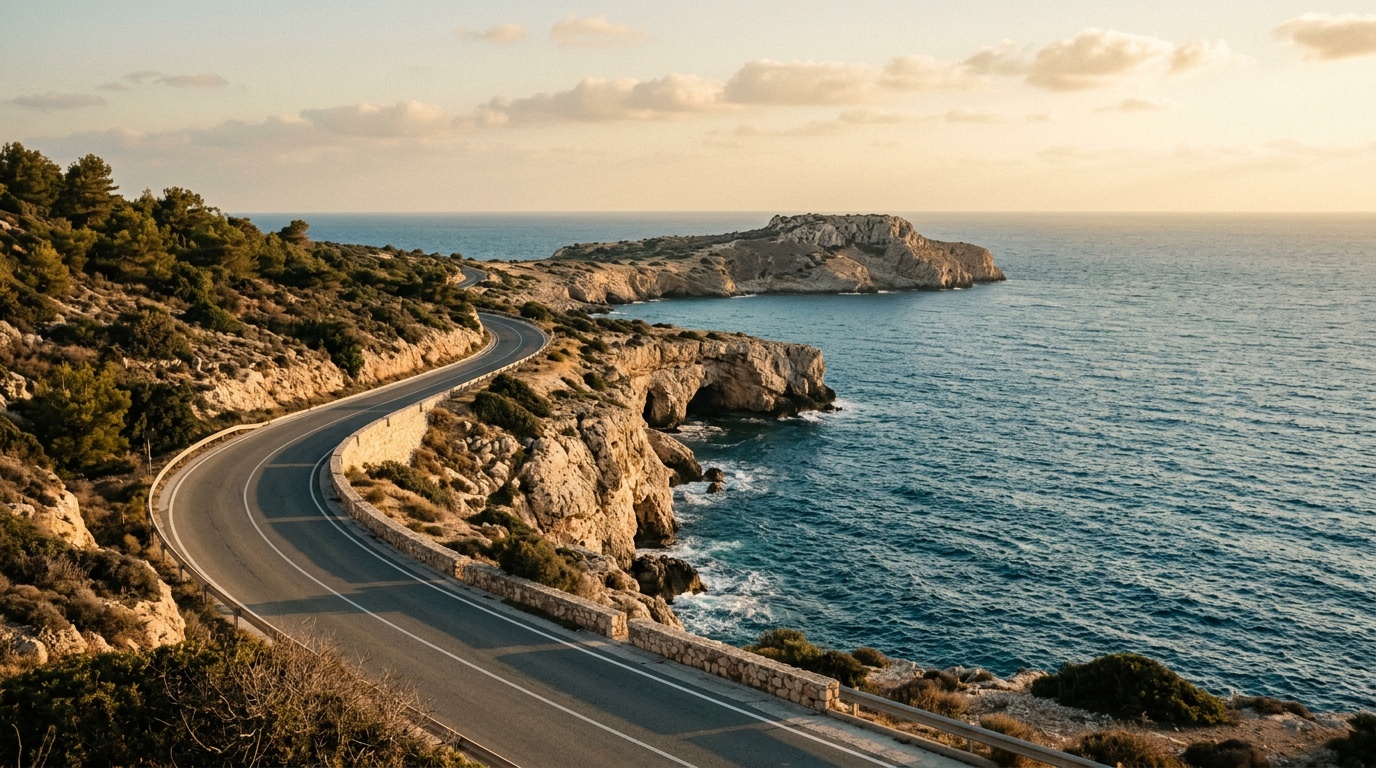
Roundabouts are the main challenge for left-hand-driving newcomers. In Cyprus, you enter a roundabout from the left and traffic flows clockwise. Priority goes to vehicles already in the roundabout. The temptation to look the wrong way and enter from the wrong lane is strongest at roundabouts, so take them slowly for the first day or two. Cypriot drivers are generally patient with rental cars – they see nervous tourists year-round and know the drill.
Town driving in Larnaca is relaxed. The city is laid out on a flat coastal plain, streets are reasonably wide, and signage is bilingual (Greek and English). The main challenge is finding parking in the Finikoudes waterfront area during summer evenings, which is more of a nuisance than a real problem.
The road to Ayia Napa and Protaras (45 km east, 30-40 min) is a popular drive for beach-goers. The A3 motorway takes you most of the way, and the final stretch through the resort towns is a well-signed dual carriageway. Cape Greco, the southeastern tip of the island, is reachable by a paved road from Ayia Napa and makes a scenic half-day excursion – sea caves, cliff walks, and some of the clearest water on the island.
The Troodos Mountains are about 90 minutes from Larnaca via the A1 to Limassol and then the B8 mountain road. The climb is steep and the road winds through pine forests with hairpin turns, but the surface is good. In winter (December-March), the highest section near Mount Olympus (1,952 meters) may require snow chains – an unusual necessity on a Mediterranean island, but real. Most agencies do not include chains; ask in advance if you plan a winter mountain drive.
The Larnaca Salt Lake, just south of the airport, is worth a quick stop – particularly from November to March, when flamingos gather in the thousands. The lakeside road runs past the Hala Sultan Tekke mosque and has a few parking pull-offs. In summer the lake dries out to a flat white crust, which is less photogenic but still unusual.
One thing that catches visitors off guard: fuel stations in Cyprus close earlier than on the mainland. In Larnaca proper, you will find 24-hour stations, but once you head into the countryside or up toward the mountains, stations may close at 6 PM or 7 PM. Top up in town before a late-afternoon mountain drive. Fuel prices run 1.30-1.40 EUR per liter for Euro 95, slightly less for diesel. Full-to-full is the standard policy – return it with the tank at the same level you received it.
Parking
Parking in Larnaca is straightforward. The Finikoudes promenade has metered street parking at 1-1.50 EUR per hour, with free parking after 7 PM and all day Sunday. Meters accept coins and some take cards. The lot near the Larnaca Marina is larger and cheaper (0.50-1 EUR per hour), with easy walking distance to the old fort, the salt lake viewpoint, and the restaurants along the waterfront.
Mackenzie Beach, near the airport, has free roadside parking that rarely fills up. The beach restaurants here are popular with locals, and the landing approach passes directly overhead – jets come in low enough that you can read the livery. It is louder than Finikoudes but free.
Hotel parking is generally not an issue in Larnaca. Most hotels and apartment complexes include parking, either in a garage or a surface lot. If you are staying at a beachfront hotel on the promenade, parking may be a block or two away in a designated area.
For the Ayia Napa and Protaras resort areas, parking is ample at the main beaches (Nissi Beach, Fig Tree Bay), though the closest spots fill up by mid-morning in summer. Free or cheap overflow lots are always within a short walk.